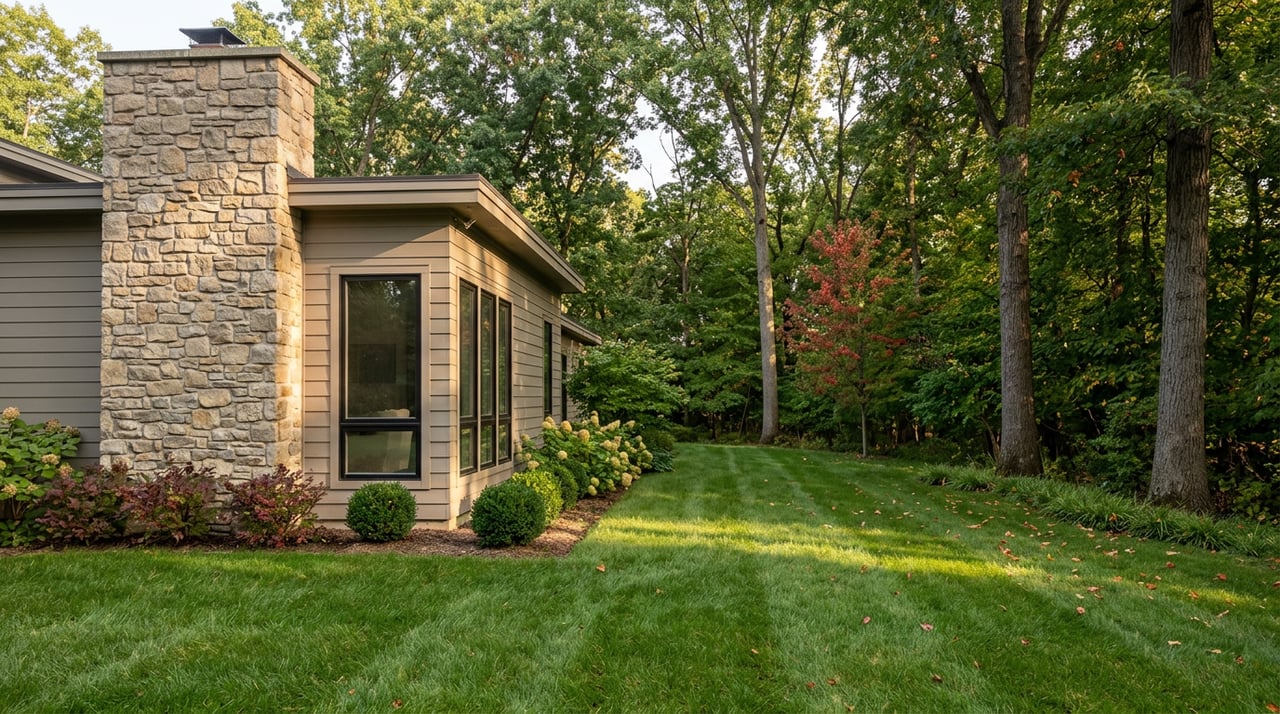
Every few months, a Great Falls homeowner calls with some version of the same plan: build a small guest house for aging parents, add a detached studio over the garage for a college-age kid who keeps coming home, or simply future-proof three wooded acres for whoever buys the property next. The land is there. The math seems obvious. Then the conversation takes a turn nobody expected, because the number that actually governs whether Fairfax County allows a detached accessory unit has nothing to do with what the plat says. It has to do with a single threshold: two acres.
That line creates a strange split in a community built almost entirely on lots larger than that, and Fairfax County is now considering moving it. Understanding why matters more than the acreage total on your listing sheet.
The Rule That Actually Draws the Line
Fairfax County calls these units Accessory Living Units, or ALUs, and it treats them very differently depending on whether the unit sits inside your existing home or stands apart from it. An interior ALU, built into a basement or an attached wing, tops out at 800 square feet or 40 percent of the home's gross floor area, whichever is smaller, and can move through an administrative permit without a public hearing. A detached ALU is a different animal. It can reach 1,200 square feet, but the county only allows it on lots of at least two acres, and it requires a special permit with a public hearing before the Board of Zoning Appeals.
For a Great Falls property, that distinction is not academic. Plenty of homes here sit on one to one and a half acres, which qualifies as spacious by regional standards but still falls short of the detached-unit threshold. The owner with three wooded acres and the owner one street over with 1.4 acres are working from entirely different rulebooks, even though both would describe their home the same way to a buyer: large lot, private setting, room to spread out.
The Constraint Nobody Puts on Their Wish List
Acreage is the visible gate. The one that catches people off guard is underground.
Most Great Falls homes run on private well and septic systems rather than county water and sewer, and Fairfax County requires Health Department approval before it will issue either an administrative permit or a special permit for an ALU on a well or septic property. That approval hinges on whether the existing septic system has the reserve capacity to support additional bedrooms and occupants, which is a separate question from whether your lot clears the two-acre line.
In practical terms, this means a seller marketing "ALU potential" needs two things lined up, not one: enough contiguous acreage for a detached structure, and a septic system with room to grow. A buyer evaluating that same listing should ask for septic records before assuming the guest house is a formality. This is the kind of friction that surfaces during a transaction rather than during a casual walk-through, and it is exactly where a listing built on assumption instead of documentation tends to stall.
Great Falls' Own Civic Voice Is Already in the Room
The Great Falls Citizens Association has not waited for this to become a closing-table surprise. Its Land Use and Zoning Committee reviewed the county's ALU study at its February 2026 meeting and has been tracking how a countywide policy shift would land differently in a community like Great Falls than it would in denser parts of Fairfax County.
The committee's stated concerns are specific rather than reflexive. Great Falls was intentionally zoned as low density, and the association has flagged that added units could bring more traffic to roads that were never built for it, along with a larger school-age population that could affect capacity in the Langley Pyramid. It has also pressed the county to evaluate septic performance, grading, stormwater impact, and watershed health as part of any Great Falls-specific analysis, and it plans to engage directly with county staff before a summer report is finalized.
That committee's reach extends beyond ALUs, too. Its docket has also carried a Special Exception case for a private Amazon greenhouse proposed at the corner of Springvale Road and Leesburg Pike, meant to grow trees and ornamental plants for the company's Arlington headquarters, a reminder that Great Falls' land-use questions run from backyard cottages to corporate horticulture, and the same civic infrastructure handles both.
The Reform That Could Erase the Advantage
Here is the part that changes how a Great Falls landowner should think about the two-acre rule rather than just comply with it.
Fairfax County staff presented a white paper to the Board of Supervisors' Land Use Policy Committee in December 2025 outlining changes under consideration for the ALU program, and the proposals go well beyond a minor tweak. Among the ideas on the table: dropping the minimum lot size for a detached ALU from two acres down to 15,000 square feet, a change the county's own analysis estimates would expand the share of eligible single-family homes from roughly 4.7 percent today to about 39 percent countywide. Other proposals include folding zoning approval into the standard building permit process instead of requiring a separate application, and revisiting the current 1,200-square-foot size cap.
| Today | Under Consideration | |
|---|---|---|
| Minimum lot for a detached ALU | 2 acres | 15,000 sq ft |
| Estimated share of county SFH lots eligible | About 4.7% | About 39% |
| Detached unit size cap | 1,200 sq ft | Under review |
| Approval path | Special permit, BZA public hearing | Possible integration into standard building permit |
Authorization and public hearings on any formal amendment could take place by the end of 2026, according to the county's own timeline in that white paper.
Sit with what that table actually says. Right now, the two-acre threshold functions as a quiet advantage for large-lot communities like Great Falls, where a meaningful share of properties already clear the bar that most of suburban Fairfax County cannot. If the county drops that minimum to 15,000 square feet, homes on a third of an acre in far denser parts of the county would suddenly compete for the same detached-unit flexibility that has, until now, been a relatively scarce feature of estate-scale land. The reform is designed to expand housing options countywide. One side effect, whether intended or not, is that it narrows the gap between what a Great Falls lot can do and what a much smaller lot elsewhere in the county can also do.
What This Means Before You List or Make an Offer
For a seller weighing whether to market a home's ALU potential, the two-acre-plus lot and a septic system with documented reserve capacity are worth verifying and disclosing now, while that combination still represents a real point of differentiation rather than a countywide baseline.
For a buyer comparing Great Falls to other Northern Virginia neighborhoods on the promise of future flexibility, the honest read is that today's advantage has a shelf life tied to a county policy process, not a permanent feature of the land itself. A lot that clears two acres and has verified septic capacity is doing real work for you right now. Whether it remains rare is a different question, one the county will answer sometime in the next several months.
For anyone assembling land for a multigenerational compound, a caregiver suite, or long-term rental flexibility, the practical move is to request septic capacity documentation and confirm current acreage against the two-acre line before treating an ALU as a given, and to watch the Board of Supervisors' public hearing calendar for when this moves from white paper to ordinance.
A Few Questions Worth Asking Directly
Does a lot already over two acres automatically qualify for a detached ALU? It clears the acreage threshold, but the county still requires a special permit and a Health Department sign-off if the property runs on well or septic. Acreage opens the door. It does not walk you through it.
What if my Great Falls home is on public water and sewer instead of a well and septic system? The Health Department approval step does not apply, which removes one layer of the process. The two-acre minimum and special permit requirement for a detached unit still apply as written today.
When would a lower lot-size threshold actually take effect? Nothing is adopted yet. The county's own materials describe possible authorization and public hearings by the end of 2026, with the LUZ Committee expecting to weigh in before a summer staff report. Anyone timing a sale or a build around this should track the county's ALU amendment page rather than a projected date.
Zoning conversations like this one are exactly where local knowledge earns its keep, because the difference between an accurate answer and a confident guess shows up months later at a permit desk or a closing table. If you are weighing what a Great Falls property can actually support, or trying to read how a pending county policy might affect a sale timeline, Great Falls Great Homes can walk the specifics with you. Request a private consultation and we will look at your lot, your systems, and the calendar together before you make a decision that depends on any of them.