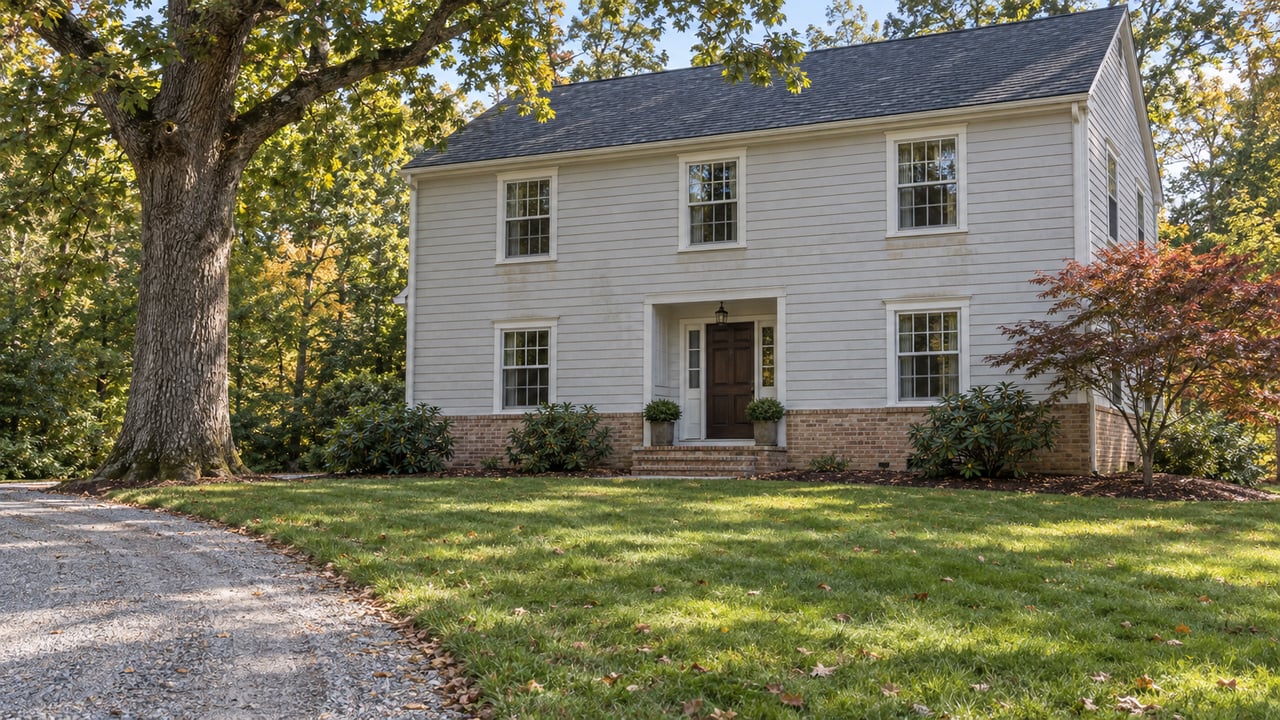
A Great Falls seller signed a contract in early September, priced right, buyer eager, ten-day inspection window ticking. On day six, the septic inspector called with news nobody had budgeted for: a full evaluation now means pumping the tank first, not just probing the drain field and writing up a certificate. The walkover that used to satisfy a buyer's lender for under a hundred dollars doesn't exist as an option anymore. The closing date, set six weeks out, suddenly looked tight.
That seller had read online that Virginia now requires a septic inspection on every home sale. Technically, that's not what the law says. Practically, in a neighborhood where almost no house sits on public sewer, the difference barely changes what happens at the closing table.
What the Statute Actually Says
House Bill 2671 was signed by Governor Youngkin on March 20, 2025, and took effect July 1, 2025. Read the bill text on the Virginia General Assembly's legislative site and the operative language is narrower than most of the internet's summary of it: an "inspection" is defined as one requested by a lending institution, a real estate licensee, a prospective buyer, or another party as a condition of sale, and that inspection must meet a new minimum standard. Virginia REALTORS's own explainer confirms the same reading: the law sets a floor for inspections that happen, not a mandate that one must happen on every transfer.
What changed on July 1 is the floor itself, and it moved considerably. Before HB 2671, a seller could satisfy paragraph 17 of the standard Virginia sales contract with a walkover certificate, a visual check of the yard for standing effluent plus a soil probe near the drain field, often completed in under an hour for less than a hundred dollars. After HB 2671, any inspection performed as a condition of sale must:
| Requirement | Before July 2025 | After July 2025 |
|---|---|---|
| Who can inspect | No standard credential required | DPOR-licensed onsite sewage system operator or soil evaluator only |
| Tank pumping | Optional, often skipped | Required as part of a complete inspection unless the inspector's written contract specifically excludes it |
| Scope | Visual walkover and drain field probing | Tank, distribution box, pump tanks, control panels, and dispersal field, physically opened and evaluated |
| Paperwork | Certificate, no contract required | Signed written contract between homeowner or agent and inspector before work begins |
| Reporting | No fixed deadline | Written report due within 10 business days |
Regional MLS purchase agreements elsewhere in Virginia have already dropped the old rod-probing-only inspection option from their forms entirely, which tells you where standard practice is heading even faster than the statute strictly requires it.
Why the Legal Nuance Barely Reaches Great Falls
Everywhere with a mix of public sewer and septic, the distinction between "the law requires this" and "the law defines this if you choose it" matters. A buyer in a sewered subdivision can waive a septic inspection because there's no septic system to inspect. That option shrinks to almost nothing in Great Falls.
The Great Falls Citizens Association, the community's longstanding civic organization, describes the area's utility profile plainly on its own site: most homes rely on private wells, and almost all of them run on septic systems rather than public water and sewer. Zoning here is Residential Estate, the county's low-density, semi-rural designation, and lot sizes in the two-to-five-acre range are typical rather than exceptional. When public water and sewer service does reach a property, it shows up as a marketing point on the listing itself, a rare enough feature that agents call it out by name.
That means the theoretical gap between "inspection optional" and "inspection expected" collapses under practical pressure specific to this market. A buyer's lender underwriting a jumbo loan on a multimillion-dollar estate is not going to accept a bare walkover on a system serving a house that size. A buyer's agent representing a relocating executive is not going to advise waiving the inspection contingency to win a competitive offer, not on a system this consequential to the property's ongoing cost of ownership. The law didn't have to force the issue in Great Falls. The stakes already had.
Local geology adds its own complication. Portions of Great Falls sit on shallow bedrock and rocky terrain, conditions that limit how a conventional gravity system can be installed and that push some properties toward mound or sand filter systems instead. Those alternative systems, formally Alternative Onsite Sewage Systems, carry a separate compliance calendar under Fairfax County rules. Fairfax County's Health Department requires AOSS inspection by a qualified operator within 180 days of system approval, then annually after that, with water sampling required once every five years. A conventional system, by contrast, needs pumping only once every five years under county code. If a Great Falls estate's system is alternative, and a meaningful share of the newer construction here is, a seller may already have a stack of annual inspection paperwork on file, which shortens the pre-listing scramble considerably.
What It Costs and How Long It Takes
Statewide in 2026, a standard HB 2671-compliant septic inspection runs $300 to $500. Northern Virginia inspections trend toward the higher end of that range, closer to $400 to $550, reflecting both labor costs and the larger, more complex systems common on estate-sized lots. Because the law now requires pumping as part of a complete evaluation, that fee typically covers the pump-out rather than adding it as a separate line item, though a seller should confirm this in the inspector's written contract before work begins, since the law explicitly requires the contract to state whether pumping is included.
A standard residential inspection takes roughly one and a half to three hours. Alternative systems, with their control panels and mechanical components, run longer. None of this is instantaneous, and none of it fits neatly inside a rushed due diligence period if the seller hasn't already located the tank access points and pulled together pump-out records before listing.
Before You Sign a Listing Agreement
A few steps, done early, keep the inspection window from becoming a negotiation forced by the calendar rather than the facts:
- Locate the tank access lids and the drain field boundaries, and confirm this information is written down somewhere a buyer's inspector can use it, not just remembered.
- Pull together every pump-out and repair receipt the property has. If the system is alternative, gather the annual inspection reports the county already required.
- Decide whether to schedule the inspection before listing. A passing report gives a seller a documented selling point and removes a source of buyer anxiety before it becomes a renegotiation lever.
- Confirm in writing with the inspector whether pumping is included in the quoted price, since the law requires this to be spelled out in the inspection contract itself.
- If the system is alternative, ask the inspector to reconcile the new HB 2671 evaluation with the county's separate annual AOSS inspection, so the two processes don't duplicate cost or paperwork.
A Few Questions Sellers Ask
Does the law say who pays for the inspection, buyer or seller? No. HB 2671 sets the standard for how an inspection must be conducted, not who bears the cost. That remains a negotiation point in the contract, same as it was before July 2025.
If my system passed an inspection last year, do I need a new one to sell? The statute doesn't set an expiration date on a prior inspection, but a buyer's lender or agent may still want current documentation given how recently the standard changed. A system with a documented pump-out and inspection within the past year is in a stronger position than one with no paper trail at all.
What if a buyer waives the inspection entirely to make the offer more competitive? Nothing in Virginia law prevents that, and in a fast-moving market it happens. It shifts the risk of a hidden system problem onto the buyer after closing, a risk that grows with the age and complexity of the system, which is worth naming honestly during negotiations rather than assuming it away.
Selling a well-and-septic estate in a market like this one rewards preparation more than paperwork. Knowing what the law actually requires, and what your specific property will require anyway, is the difference between a ten-day window and a ten-week delay. If you're weighing when to list a Great Falls property and want to walk through what your system's history means for timing, Great Falls Great Homes offers a private consultation to work through it before it becomes a closing-day surprise.