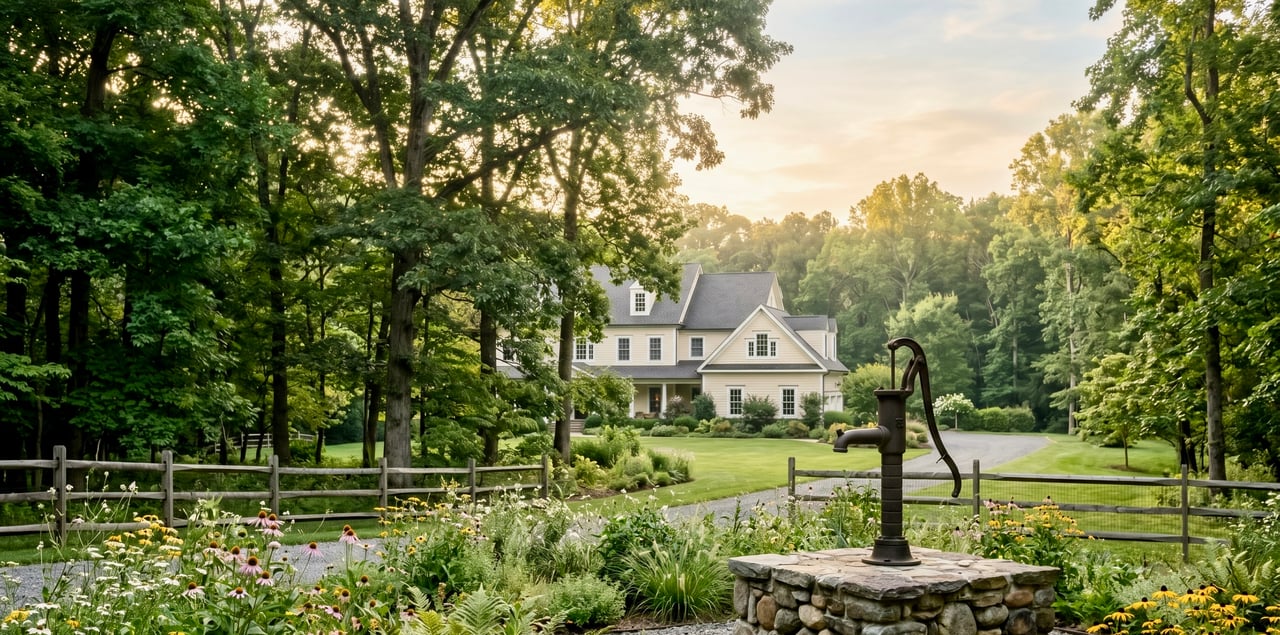
If you're house hunting in Great Falls, you've probably noticed something that catches people off guard: nearly every home here runs on a private well and septic system. In most of Fairfax County, that would be the exception. Here, it's 85% of the rule. The story behind it says a lot about the uniqueness of this community.
IT STARTED ON THE FARM
Great Falls wasn't always a luxury enclave. Colonial farm settlements started forming here as early as the late 1700’s, and the land stayed agricultural for a long time. Dairy farming was the backbone of the local economy, and farms ran on wells. That infrastructure stuck around long after the farms were gone.
THE TIME GREAT FALLS SAID NO TO PUBLIC WATER
When Fairfax County proposed running a water main into parts of Great Falls in 2005, residents pushed back, even some who stood to benefit directly. The reason was simple: development almost inevitably follows piped water. And Great Falls didn't want that. The large lots, the tree canopy, the quiet -- it didn't happen by accident.
WHAT'S ACTUALLY IN THE GROUND HERE
Great Falls sits in Virginia's Piedmont region, where groundwater is found in fractures of crystalline bedrock and is not evenly distributed. Two homes on the same street can have meaningfully different wells: different depths, different flow rates, different water chemistry.
Hard vs. Acidic Water
Water quality depends largely on which aquifer your well taps into. In areas with carbonate rock, water tends to be hard, high in calcium and magnesium, with a pH around 7.5. Hard water is safe to drink but leaves scale on fixtures and appliances. A water softener minimizes this condition.
In other parts of the Piedmont, the picture flips. Acidic water (pH below 7.0) is more common near the Blue Ridge and parts of the Piedmont. It's also safe to drink but can corrode pipes over time if untreated. A neutralizer filter is the fix.
You won't know which situation applies until the testing is completed.
Flow Rate: How Much Water Does the Well Produce?
Flow rate, measured in gallons per minute (GPM), is something many buyers overlook. A good residential well produces 5 to 10 GPM. Under 5 GPM is considered low, and under 3 GPM typically requires a storage tank. A licensed well contractor can perform a yield test to tell you exactly where a property stands.
WHAT BUYERS NEED TO KNOW BEFORE CLOSING
-
Get a separate well inspection. A standard home inspection won't cover it, and well repairs can be costly.
-
Know what to test. At minimum: bacteria, nitrates, pH, and any contaminants of local concern (arsenic, lead, radon). Basic lender-required tests often don't go far enough.
-
Bacteria is a dealbreaker. Unlike hard or acidic water, bacterial contamination requires treatment and re-testing before closing. Don't waive this step.
-
Make your contract contingent on results. A water quality test is just as important as a septic or termite inspection.
-
Sellers: get ahead of it. A home that's already been tested and cleared is a selling point. It's one less thing for buyers to worry about at the closing table.
THE BOTTOM LINE
Great Falls residents value their well water, with many saying it simply tastes better than treated public water. It's one of the unique characteristics that helps define the community and its rural charm.
The Dianne Van Volkenburg Team has spent decades helping buyers and sellers navigate every aspect of the Great Falls market—from wells and septic systems to luxury estates and new construction. When you're ready to discuss your real estate goals, we're here to help